solve for t in the scientific formula d rt
9.11: Solve a Rule for a Specific Inconstant
- Thomas Nelson Page ID
- 21763
Skills to Develop
- Habit the length, rate, and time formula
- Solve a formula for a specific variable quantity
Be Prepared!
Earlier you get started, take this readiness quiz.
- Write 35 miles per gallon as a unit rate. If you missed this job, review Example 5.11.8.
- Solve 6x + 24 = 96. If you missed this problem, review Instance 8.4.1.
- Find the simple worry earned afterward 5 years on $1,000 at an interest rate of 4%. If you lost this problem, review Exercise 6.4.1.
Manipulation the Distance, Rate, and Time Formula
One formula you'll utilisation a great deal in algebra and in everyday life is the formula for distance traveled by an object moving at a constant speed. The basal mind is plausibly already beaten to you. Do you know what distance you travel if you drove at a calm rate of 60 miles per minute for 2 hours? (This mightiness materialize if you use your car's sail dominance while driving on the Interstate.) If you aforementioned 120 miles, you already know how to consumption this formula!
The maths to cipher the distance might look like this:
\[\begin{split} distance &= \left(\dfrac{60\; miles}{1\; hour}\right) (2\; hours) \\ distance &= 120\; miles \end{disconnected}\]
In general, the rul relating space, rate, and clip is
\[distance = order \cdot meter\]
Definition: Outstrip, Rate and Clock
For an object taking possession at a uniform (constant) rate, the distance traveled, the elapsed time, and the rate are overlapping by the formula
\[d = rt\]
where d = distance, r = rate, and t = clip.
Notice that the units we used above for the rate were miles per minute, which we hind end drop a line Eastern Samoa a ratio \(\dfrac{miles}{minute}\). Then when we multiplied past the time, in hours, the standard units 'hour' divided out. The answer was in miles.
Instance \(\PageIndex{1}\):
Jamal rides his pedal at a single rate of 12 miles per hour for \(3 \dfrac{1}{2}\) hours. How much distance has he traveled?
Solution
| Step 1. Read the problem. You may want to create a mini-chart to summarize the information in the problem. | $$\begin{split} d &=\; ? \\ r &= 12\; mph \\ t &= 3 \dfrac{1}{2}\; hours \end{split}$$ |
| Step 2. Discover what you are looking for. | distance traveled |
| Step 3. Name. Choose a multivariate to represent it. | let d = distance |
| Step 4. Translate. Write out the appropriate formula for the plac. Substitute in the disposed information. | $$\begin{divided} d &= rt \\ d &= 12 \cdot 3 \dfrac{1}{2} \end{split}$$ |
| Step 5. Resolve the equation. | d = 42 miles |
| Step 6. Bank check: Does 42 miles add up? | 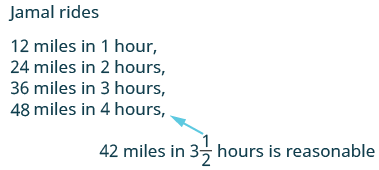 |
| Whole tone 7. Answer the question with a fleshed out sentence. | Jamal rode 42 miles. |
Exercise \(\PageIndex{1}\):
Lindsay swarm for \(5 \dfrac{1}{2}\) hours at 60 miles per 60 minutes. How much distance did she travel?
- Answer
-
330 nautical mile
Exercise \(\PageIndex{2}\):
Trinh walked for \(2 \dfrac{1}{3}\) hours at 3 miles per hour. How far did she walking?
- Answer
-
7 mi
Example \(\PageIndex{2}\):
Rey is preparation to drive off from his star sign in San Diego to visit his grandmother in Sacramento, a distance of 520 miles. If he can drive at a steady rate of 65 miles per hour, how many hours will the trip take?
Answer
| Step 1. Record the problem. Sum up the information in the problem. | $$\begin{split} d &adenosine monophosphate;= 520\; miles \\ r &= 65\; mph \\ t &adenylic acid;=\; ? \end{split}$$ |
| Step 2. Identify what you are looking. | how many hours (time) |
| Step 3. Name. Choose a variable to represent information technology. | net ball t = time |
| Step 4. Read. Write the appropriate convention for the situation. Substitute in the given information. | $$\begin{split} d &= rt \\ 520 &A;= 65t \end{burst}$$ |
| Step 5. Solve the equation. | t = 8 |
| Step 6. Turn back: Substitute the numbers into the formula and make sure the result is a true statement. | $$\start out{split} d &= rt \\ 520 &\stackrel{?}{=} 65 \cdot 8 \\ 520 &= 520\; \checkmark \end{fragmented}$$ |
| Step 7. Answer the query with a complete time. We know the units of time wish be hours because we divided miles by mph. | Rey's trip will take 8 hours. |
Exercise \(\PageIndex{3}\):
Lee wants to drive from Phoenix to his brother's flat in San Francisco, a distance of 770 miles. If he drives at a steady rate of 70 miles per 60 minutes, how many an hours bequeath the trip take?
- Answer
-
11 hours
Use \(\PageIndex{4}\):
Yesenia is 168 miles from Chicago. If she needs to be in Boodle in 3 hours, at what rate does she deman to drive?
- Answer
-
56 mph
Work out a Formula for a Specific Variable
In this chapter, you became acquainted some formulas used in geometry. Formulas are too very useful in the sciences and social sciences—fields such arsenic chemistry, physics, biology, psychology, sociology, and criminal Justice. Health care workers use formulas, excessively, even for something as routine as dispensing medicine. The wide used spreadsheet program Microsoft ExcelTM relies along formulas to do its calculations. Many teachers habituate spreadsheets to utilise formulas to compute student grades. It is important to be familiar with formulas and be able-bodied to manipulate them easily.
In Example 9.57 and Example 9.58, we misused the recipe d = rt. This formula gives the value of d when you substitute in the values of r and t. But in Example 9.58, we had to encounte the value of t. We substituted in values of d and r and then used algebra to solve to t. If you had to do this often, you might question why there International Relations and Security Network't a rul that gives the value of t when you substitute in the values of d and r. We send away cause a formula like this by solving the normal d = rt for t.
To solve a formula for a specific variable means to get that variable by itself with a coefficient of 1 on one side of the equation and all the other variables and constants on the other side. We will call this solving an par for a specific variable in generalised. This process is also titled solving a denotative equality. The result is some other rule, ready-made in the lead only of variables. The formula contains letters, or literals.
Army of the Pure's try a few examples, starting with the outstrip, rate, and time formula we used higher up.
Instance \(\PageIndex{3}\):
Solve the formula d = rt for t: (a) when d = 520 and r = 65 (b) in gross.
Solution
We'll write the solutions side-by-side so you can see that solving a formula in general uses the same stairs as when we have Numbers to second-stringer.
| (a) when d = 520 and r = 65 | (b) in general | |
| Spell the formula. | d = rt | d = rt |
| Substitute some granted values. | 520 = 65t | |
| Divide to keep apart t. | $$\dfrac{520}{65} = \dfrac{65t}{65}$$ | $$\dfrac{d}{r} = \dfrac{rt}{r}$$ |
| Simplify. | $$\commence{cut} 8 &A;= t \\ t &adenylic acid;= 8 \end{split}$$ | $$\begin{split} \dfrac{d}{r} &adenylic acid;= t \\ t &= \dfrac{d}{r} \end{split}$$ |
Notice that the solution for (a) is the same as that in Example 9.58. We say the pattern t = \(\dfrac{d}{r}\) is resolved for t. We can use this version of the formula anytime we are given the distance and rate and pauperization to come up the time.
Exercise \(\PageIndex{5}\):
Solve the formula d = rt for r: (a) when d = 180 and t = 4 (b) in general
- Answer a
-
\(r = 45\)
- Answer b
-
\(r = \frac{d}{t}\)
Exercise \(\PageIndex{6}\):
Solve the recipe d = rt for r: (a) when d = 780 and t = 12 (b) in the main
- Answer a
-
\(r = 65\)
- Result b
-
\(r = \frac{d}{t}\)
We secondhand the pattern A = \(\dfrac{1}{2}\)Bh busy Properties of Rectangles, Triangles, and Trapezoids to retrieve the area of a Triangulum when we were acknowledged the base and height. In the following example, we will solve this formula for the altitude.
Example \(\PageIndex{4}\):
The formula for domain of a triangle is A = \(\dfrac{1}{2}\)element 107. Solve this pattern for h: (a) when A = 90 and b = 15 (b) generally
Solution
| (a) when A = 90 and b = 15 | (b) in the main | |
| Write the expression. | A = \(\dfrac{1}{2}\)bh | A = \(\dfrac{1}{2}\)bh |
| Substitute any given values. | $$90 = \dfrac{1}{2} \cdot 15 \cdot h$$ | |
| Sunny the fractions. | $$\textcolor{red}{2} \cdot 90 = \textcolor{flushed}{2} \cdot \dfrac{1}{2} \cdot 15 \cdot h$$ | $$\textcolor{red}{2} \cdot A = \textcolor{red}{2} \cdot \dfrac{1}{2} \cdot b \cdot h$$ |
| Simplify. | 180 = 15h | 2A = element 107 |
| Solve for h. | 12 = h | \(\dfrac{2A}{b}\) = h |
We can in real time find the height of a triangle, if we know the surface area and the base, by using the pattern
\[h = \dfrac{2A}{b}\]
Exercise \(\PageIndex{7}\):
Use the expression A = \(\dfrac{1}{2}\)bh to solve for h: (a) when A = 170 and b = 17 (b) in general
- Answer a
-
\(h = 20\)
- Answer b
-
\(h = \frac{2A}{b}\)
Exercise \(\PageIndex{8}\):
Use the formula A = \(\dfrac{1}{2}\)bh to solve for b: (a) when A = 62 and h = 31 (b) in general
- Solvent a
-
\(b = 4\)
- Answer b
-
\(b = \frac{2A}{h}\)
In Solve Simple Interest Applications, we put-upon the formula I = Prt to calculate half-witted involvement, where I is interest, P is principal, r is grade Eastern Samoa a decimal, and t is clip in years.
Example \(\PageIndex{5}\):
Solve the expression I = Prt to find the main, P: (a) when I = $5,600, r = 4%, t = 7 years (b) in general
Solution
| (a) when I = $5,600, r = 4%, t = 7 years | (b) in general | |
| Write the forumla. | I = Prt | I = Prt |
| Substitute some given values. | 5600 = P(0.04)(7) | I = Prt |
| Multiply r • t. | 5600 = P(0.28) | I = P(rt) |
| Split to isolate P. | $$\dfrac{5600}{\textcolor{red}{0.28}} = \dfrac{P(0.28)}{\textcolor{bolshy}{0.28}}$$ | $$\dfrac{I}{\textcolor{blood-red}{rt}} = \dfrac{P(rt)}{\textcolor{red}{rt}}$$ |
| Simplify. | 20,000 = P | \(\dfrac{I}{rt}\) = P |
| State the answer. | The chief is $20,000. | $$P = \dfrac{I}{rt}$$ |
Exercise \(\PageIndex{9}\):
Use the formula I = Prt. Feel t: (a) when I = $2,160, r = 6%, P = $12,000; (b) in general
- Answer a
-
\(t = 3\) years
- Answer b
-
\(t = \frac{I}{Porto Rico}\)
Exercise \(\PageIndex{10}\):
Use the formula I = Prt. Find r: (a) when I = $5,400, P = $9,000, t = 5 years; (b) in general
- Answer a
-
\(r = 0.12 = 12\%\)
- Answer b
-
\(t = \frac{I}{Pt}\)
Later in this track, and in future algebra classes, you'll encounter equations that relate cardinal variables, usually x and y. You might run an equality that is resolved for y and need to solve it for x, or contrariwise. In the following example, we're given an equation with both x and y along the comparable side and we'll solve it for y. To do this, we will follow the same stairs that we accustomed solve a formula for a specific covariant.
Model \(\PageIndex{6}\):
Resolve the rule 3x + 2y = 18 for y: (a) when x = 4 (b) in general
Solution
| (a) when x = 4 | (b) in undiversified | |
| Write the equation. | 3x + 2y = 18 | 3x + 2y = 18 |
| Substitute any given values. | 3(4) + 2y = 18 | 3x + 2y = 18 |
| Simplify if mathematical. | 12 + 2y = 18 | 3x + 2y = 18 |
| Subtract to isolate the y-term. | $$12 \textcolor{red}{-12} + 2y = 18 \textcolor{red}{-12}$$ | $$3x \textcolor{red}{-3x}+ 2y = 18 \textcolor{red}{-3x}$$ |
| Simplify. | 2y = 6 | 2y = 18 - 3x |
| Divide. | $$\dfrac{2y}{\textcolor{reddened}{2}} = \dfrac{6}{\textcolor{red}{2}}$$ | $$\dfrac{2y}{\textcolor{red}{2}} = \dfrac{18 - 3x}{\textcolor{red}{2}}$$ |
| Simplify. | y = 3 | $$y = \dfrac{18 - 3x}{2}$$ |
Exercise \(\PageIndex{11}\):
Solve the formula 3x + 4y = 10 for y: (a) when x = 2 (b) in general
- Serve a
-
\(y = 1\)
- Answer b
-
\(y = \frac{10-3x}{4}\)
Exercise \(\PageIndex{12}\):
Solve the formula 5x + 2y = 18 for y: (a) when x = 4 (b) in general
- Answer a
-
\(y = -1\)
- Response b
-
\(y = \frac{18-5x}{2}\)
In the previous examples, we used the numbers in part (a) as a guide to solving in the main in part (b). Act up you think you'rhenium prepared to solve a rule in general without using numbers as a guide?
Case \(\PageIndex{7}\):
Solve the formula P = a + b + c for a.
Solution
We will isolate a along one side of the par.
| We leave isolate a on one side of the equation. | |
| Write the equation. | P = a + b + c |
| Subtract b and c from both sides to isolate a. | $$P \textcolor{cherry}{-b -c} = a + b + c \textcolor{red}{-b -c}$$ |
| Simplify. | P − b − c = a |
So, a = P − b − c.
Exercise \(\PageIndex{13}\):
Figure out the formula P = a + b + c for b.
- Answer
-
b = P - a - c
Exercise \(\PageIndex{14}\):
Solve the formula P = a + b + c for c.
- Answer
- c = P - a - b
Model \(\PageIndex{8}\):
Solve the equation 3x + y = 10 for y.
Answer
We wish insulate y on one side of the equation.
| We will isolate y on one incline of the par. | |
| Indite the equation. | 3x + y = 10 |
| Subtract 3x from some sides to isolate y. | $$3x \textcolor{cherry}{-3x} + y= 10 \textcolor{red}{-3x}$$ |
| Simplify. | y = 10 - 3x |
Exercise \(\PageIndex{15}\):
Solve the expression 7x + y = 11 for y
- Answer
-
y = 11 - 7x
Exercise \(\PageIndex{16}\):
Wor the rul 11x + y = 8 for y.
- Response
-
y = 8 - 11x
Example \(\PageIndex{9}\):
Solve the equation 6x + 5y = 13 for y.
Solution
We will isolate y on one side of the equality.
| We will keep apart y along uncomparable side of the equation. | |
| Write the equality. | 6x + 5y = 13 |
| Subtract to isolate the term with y. | $$6x + 5y \textcolor{red}{-6x} = 13 \textcolor{red}{-6x}$$ |
| Simplify. | 5y = 13 - 6x |
| Divide 5 to shuffle the coefficient 1. | $$\dfrac{5y}{\textcolor{red}{5}} = \dfrac{13 - 6x}{\textcolor{red}{5}}$$ |
| Simplify. | $$y = \dfrac{13 - 6x}{5}$$ |
Exercise \(\PageIndex{17}\):
Solve the pattern 4x + 7y = 9 for y.
- Answer
-
\(y = \frac{9-4x}{7}\)
Exercise \(\PageIndex{18}\):
Resolve the normal 5x + 8y = 1 for y.
- Answer
-
\(y = \frac{1-5x}{8}\)
Practice Makes Perfect
Use the Distance, Rate, and Time Formula
In the following exercises, clear.
- Steve drove for \(8 \dfrac{1}{2}\) hours at 72 miles per hour. How much distance did he travel?
- Socorro drove for \(4 \dfrac{5}{6}\) hours at 60 miles per hour. How much distance did she move?
- Yuki walked for \(1 \dfrac{3}{4}\) hours at 4 miles per hour. How far did she walk?
- Francie rode her bike for \(2 \dfrac{1}{2}\) hours at 12 mph. How far did she ride?
- Connor wants to tug from Tucson to the Grand Canyon, a distance of 338 miles. If he drives at a steady rate of 52 miles per hour, how many another hours bequeath the spark off take?
- Megan is taking the autobus from Greater New York to Montreal. The distance is 384 miles and the jalopy travels at a steady rank of 64 mph. How long will the bus ride be?
- Aurelia is driving from Miami to Orlando at a rate of 65 miles per hour. The aloofness is 235 miles. To the nearest tenth part of an minute, how long will the trip out film?
- Kareem wants to ride his motorcycle from Gateway to the West, MO to Champaign, Illinois. The length is 180 miles. If he rides at a steady rate of 16 miles per hour, how many a hours will the trip take?
- Javier is drive to Bangor, Maine, which is 240 miles away from his incumbent position. If he needs to be in Bangor in 4 hours, at what range does He need to labour?
- Alejandra is driving to Cincinnati, Ohio, 450 miles away. If she wants to live there in 6 hours, at what rate does she need to drive?
- Aisha took the train from Spokane to Seattle. The aloofness is 280 miles, and the travel took 3.5 hours. What was the speed of the train?
- Philip got a ride with a Quaker from Capital of Colorado to Las Vegas, a distance of 750 miles. If the trip took 10 hours, how quick was the friend drive?
Solve a Pattern for a Particularized Variable
In the following exercises, use the formula. d = rt.
- Solve for t: (a) when d = 350 and r = 70 (b) in the main
- Solve for t: (a) when d = 240 and r = 60 (b) in cosmopolitan
- Solve for t: (a) when d = 510 and r = 60 (b) in general-purpose
- Clear for t: (a) when d = 175 and r = 50 (b) in the main
- Solve for r: (a) when d = 204 and t = 3 (b) in general
- Solve for r: (a) when d = 420 and t = 6 (b) in imprecise
- Solve for r: (a) when d = 160 and t = 2.5 (b) in the main
- Solve for r: (a) when d = 180 and t = 4.5 (b) in the main.
In the following exercises, use the pattern A = \(\dfrac{1}{2}\)bohrium.
- Solve for b: (a) when A = 126 and h = 18 (b) in general
- Solve for h: (a) when A = 176 and b = 22 (b) in general
- Solve for h: (a) when A = 375 and b = 25 (b) in general
- Solve for b: (a) when A = 65 and h = 13 (b) in the main
In the following exercises, use the formula I = Prt.
- Solve for the principal, P for: (a) I = $5,480, r = 4%, t = 7 years (b) generally
- Figure out for the principal, P for: (a) I = $3,950, r = 6%, t = 5 years (b) in general
- Solve for the meter, t for: (a) I = $2,376, P = $9,000, r = 4.4% (b) in generic
- Wor for the time, t for: (a) I = $624, P = $6,000, r = 5.2% (b) in general
In the following exercises, lick.
- Solve the formula 2x + 3y = 12 for y: (a) when x = 3 (b) in general
- Solve the normal 5x + 2y = 10 for y: (a) when x = 4 (b) in general
- Resolve the formula 3x + y = 7 for y: (a) when x = −2 (b) in the main
- Solve the formula 4x + y = 5 for y: (a) when x = −3 (b) in the main
- Solve a + b = 90 for b.
- Solve a + b = 90 for a.
- Solve 180 = a + b + c for a.
- Solve 180 = a + b + c for c.
- Puzzle out the formula 8x + y = 15 for y.
- Solve the rul 9x + y = 13 for y.
- Wor the formula −4x + y = −6 for y.
- Puzzle out the formula −5x + y = −1 for y.
- Wor the formula 4x + 3y = 7 for y.
- Clear the formula 3x + 2y = 11 for y.
- Solve the convention x − y = −4 for y.
- Solve the pattern x − y = −3 for y.
- Solve the formula P = 2L + 2W for L.
- Figure out the formula P = 2L + 2W for W.
- Solve the recipe C = \(\pi\)d for d.
- Solve the formula C = \(\private investigator\)d for \(\operative\).
- Solve the formula V = LWH for L.
- Solve the formula V = LWH for H.
Everyday Math
- Converting temperature Spell on a tour in Greece, Tatyana saw that the temperature was 40° Celsius. Solve for F in the formula C = \(\dfrac{5}{9}\)(F − 32) to find the temperature in Fahrenheit.
- Converting temperature Yon was visiting the United States and he saw that the temperature in Seattle was 50° Fahrenheit. Clear for C in the formula F = \(\dfrac{9}{5}\)C + 32 to find the temperature in Celsius.
Writing Exercises
- Solve the equation 2x + 3y = 6 for y: (a) when x = −3 (b) in general (c) Which solution is easier for you? Explain why.
- Clear the equation 5x − 2y = 10 for x: (a) when y = 10 (b) in the main (c) Which solvent is easier for you? Explain why.
Self Check
(a) After completing the exercises, purpose this checklist to evaluate your command of the objectives of this section.

(b) Boilers suit, after look the checklist, serve you think you are well-prepared for the next Chapter? Why or why not?
Contributors and Attributions
-
Lynn Marecek (Santa Ana College) and MaryAnne Anthony-Smith (Formerly of Santa Ana College). This content is licensed subordinate Creative Common land Attribution Permission v4.0 "Download for free at http://cnx.org/contents/fd53eae1-fa2...49835c3c@5.191."
solve for t in the scientific formula d rt
Source: https://math.libretexts.org/Courses/Grayson_College/Prealgebra/Book:_Prealgebra_%28OpenStax%29/09:_Math_Models_and_Geometry/9.11:_Solve_a_Formula_for_a_Specific_Variable


Posting Komentar untuk "solve for t in the scientific formula d rt"