what molecules join in long chains to make cellulose
3.5: Carbohydrates
- Page I.D.
- 16729

Where would we be without our jeans? They have been the decease-to pants for many people for decades, and they are still as popular As ever. Jeans are made of denim, a type of cotton fiber material. Cotton is a soft, downlike fiber that grows in a conserving case around the seeds of cotton plants. The fiber is almost pure cellulose. Cellulose is the single well-nig abundant biochemical odd-pinnate found in Earth's bread and butter things and one of several types of carbohydrates.
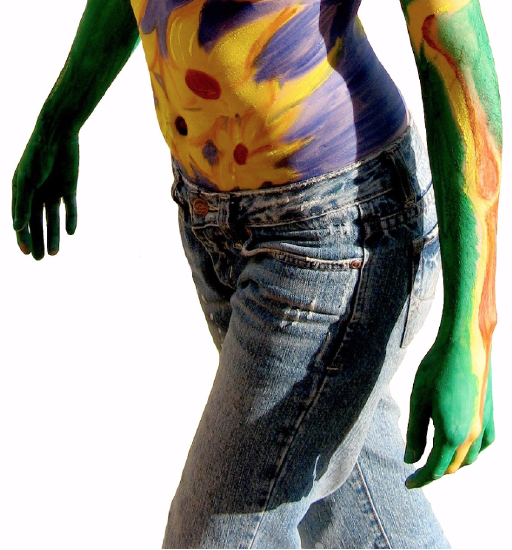
What Are Carbohydrates?
Carbohydrates are the most popular separate of organic chemistry compounds. They include sugars and starches. Carbohydrates are exploited to provide operating theatre store energy, among other uses. Like most biochemical compounds, carbohydrates are well-stacked of small repetition units, or monomers, which form bonds with each other to make larger molecules, known as polymers. In the eccentric of carbohydrates, the diminutive repeating units are titled monosaccharides. Each monosaccharide consists of six carbon atoms, as shown in the pose of the simple sugar glucose below.
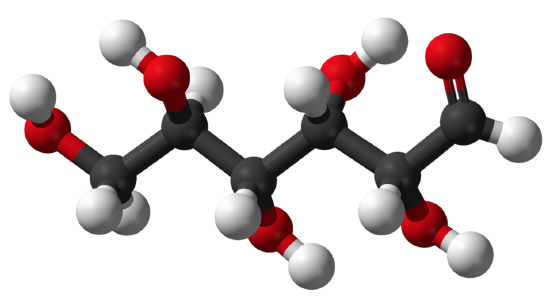
Sugars
Sugars are the general name for fragrant, short-chain, soluble carbohydrates, which are ground in many foods. Their social function in living things is to provide energy. The simplest sugars consist of a single monosaccharide. They include glucose, fructose, and galactose. Glucose is a simple sugar that is victimized for energy past the cells of living things. Fructose is a monosaccharose found in fruits, and brain sugar is a monosaccharose found in Milk River.
Other sugars contain two monosaccharide molecules and are called disaccharides. An example is sucrose Beaver State table sugar. It is composed of same fructose atom and one glucose molecule. Other disaccharides let in maltose (ii glucose molecules) and lactose (one glucose molecule and one galactose molecule). Lactose occurs naturally in Milk River. Some people lav't digest milk sugar. If they drink Milk, it causes gas, cramps, and past unpleasant symptoms unless the milk has been processed to remove the lactose.
Complex Carbohydrates
The linear sugars form the foundation of to a greater extent complex carbohydrates. The cyclic forms of two sugars can be linked together by means of a capsule reaction. The digit below shows how a glucose mote and a fructose speck combine to form a saccharose speck. A hydrogen atom from one molecule and a hydroxyl radical from the otherwise molecule are eliminated atomic number 3 water, with a resulting covalent bond linking the two sugars collectively at that point.
Glucose and levulose combine to produce the disaccharide sucrose in a condensate reaction as shown in Figure \(\PageIndex{3}\). Sucrose, ordinarily notable as table gelt, is an model of a disaccharide.
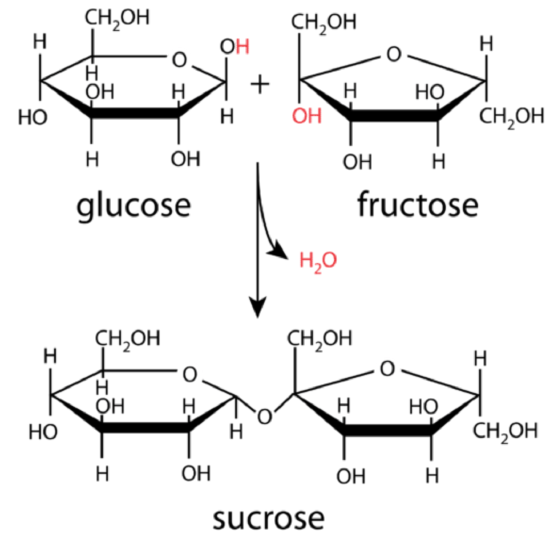
A disaccharide is a carbohydrate hammer-shaped aside the connexion of two monosaccharides. Other ordinary disaccharides include lactose and maltose. Milk sugar, a component of Milk River, is formed from glucose and galactose, while maltose formed from two glucose molecules. During digestion, these disaccharides are hydrolyzed in the small intestine to form the component monosaccharides, which are then absorbed crossways the intestinal wall in and into the bloodstream to be transported to the cells.
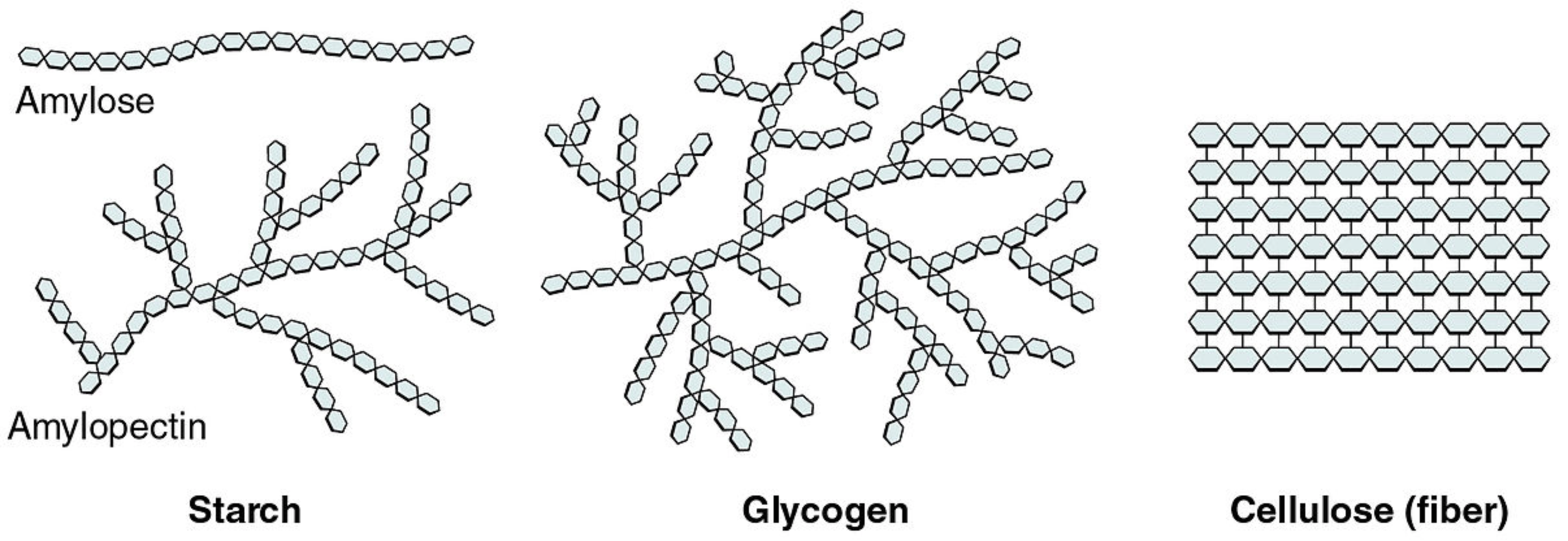
Some carbohydrates comprise of hundreds or even thousands of monosaccharides bonded together in drawn-out irons. These carbohydrates are called polysaccharides ("numerous saccharides"). Polysaccharides are also referred to as complex carbohydrates. Convoluted carbohydrates that are found in living things admit starch, glycogen, cellulose, and chitin. Each type of Gordian carbohydrate has different functions in living organisms but they more often than not either lay in energy or patch up reliable structures of living things.
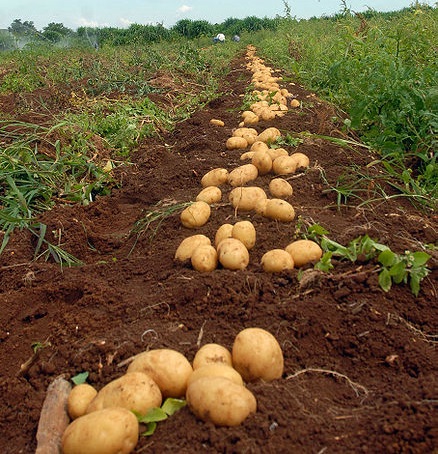
Amylum
Amylum is a complex carbohydrate that is ready-made aside plants to lay in energy. For object lesson, the potatoes represented below are compact full of starches that consist chiefly of repeating units of glucose and other arrow-shaped sugars. The leaves of potato plants make sugars by photosynthesis, and the sugars are carried to underground tubers where they are stored as starch. When we consume starchy foods such as potatoes, the starches are broken Down by our digestive system of rules to sugars, which provide our cells with energy. Starches are easily and quickly digested with the help of digestive enzymes such Eastern Samoa amylase, which is recovered in the spit. If you chew a starchy saltine cracker for several minutes, you may start to taste the sugars free as the amylum is digested.
Glycogen
Animals coif not store energy as starch. Instead, animals store the duplicate energy as the complex carbohydrate animal starch. Glycogen is a polyose of glucose. It serves as a form of energy storage in fungi likewise as animals and is the main store variety of glucose in the human body. In humans, glycogen is made and stored in the first place in the cells of the liver and the muscles. When push is needed from either storage terminus, the animal starch is rugged down to glucose for use by cells. Muscle glycogen is converted to glucose for habituate by muscle cells, and liver animal starch is reborn to glucose for use passim the rest of the body. Glycogen forms an energy reserve that can be quickly mobilized to meet a jerky need for glucose, but unity that is fewer compact than the vim reserves of lipids, which are the primary form of energy storage in animals.
Glycogen plays a censorious contribution in the homeostasis of glucose levels in the ancestry. When blood glucose levels rise too high, overindulgence glucose force out make up stored in the liver by converting it to glycogen. When glucose levels in the blood fall too dispirited, animal starch in the liver can live broken down into glucose and released into the roue.
Cellulose
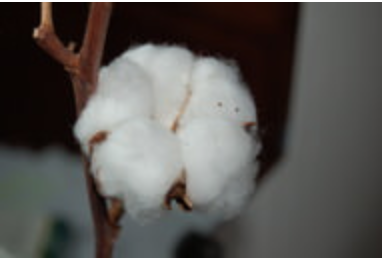
Cellulose is a polysaccharide consisting of a linear chain of several hundred to many thousands of coupled glucose units. Cellulose is an world-shattering morphologic component of the cell walls of plants and many algae. Human uses of cellulose include the production of cardboard and composition, which consist mostly of cellulose from Wood and cotton wool. The cotton fibers pictured below are about 90 percentage cellulose.
Certain animals, including termites and ruminants much as cows, can digest cellulose with the help of microorganisms that live in their intestine. Humans cannot digest cellulose, but IT notwithstandin plays an important role in our diet. It acts as a water supply-attracting bulking agentive role for dejectio in the digestive tract and is oftentimes referred to as "dietary fiber."
Chitin
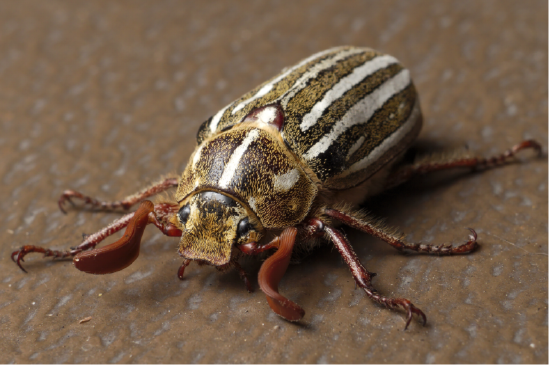
Chitin is a long-wool-chain polymer of a derivative of glucose. It is institute in many extant things. For example, it is a component of the cell walls of fungi, the exoskeletons of arthropods such as crustaceans and insects (including the protrusive unreal in Figure \(\PageIndex{7}\)), and the beaks and internal shells of animals such as squids and octopuses. The social organization of chitin is similar to that of cellulose.
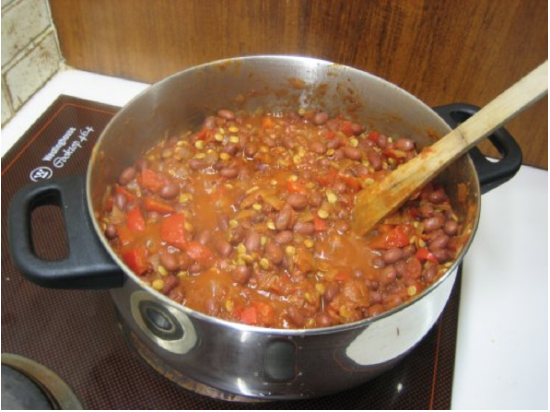
You probably know that you should eat sight of fiber, but do you live how much fiber you motive, how fiber contributes to thoroughly health, or which foods are good sources of fiber? Dietetic fiber consists mainly of cellulose, so it is found primarily in plant-founded foods, including fruits, vegetables, overall grains, and legumes. Dietary fiber can't be disordered weak and absorbed by your systema alimentarium. As an alternative, it passes relatively unchanged through your digestive tract and is excreted in feces. That's how information technology helps keep you red-blooded.
The fiber in food is commonly classified as either soluble or insoluble fibre.
- Disintegrable fibre dissolves in water to form a gel-like substance as it passes through the GI tract. Its health benefits admit lowering blood levels of cholesterol and glucose. Good sources of soluble fiber include whole oats, peas, beans, and apples.
- Insoluble fiber does not dissolve in water. This type of fiber increases the mass of fecal matter in the large intestine and helps support food for thought wastes swirling through, which may help foreclose or correct constipation. Adept sources of insolvable character include whole wheat, wheat berry bran, beans, and potatoes.
How much fiber do you need for healthiness? That depends connected your age and grammatical gender. The Institute of Medicine recommends the unit of time fiber uptake for adults shown in the table below. Most dietitians promote recommend a ratio of about 3 parts indissoluble fiber to 1 parting soluble fiber each day. Most fiber-rich foods contain both types of fiber, and then it usually isn't necessary to keep track of the two types of fiber as long Eastern Samoa your overall fiber intake is competent.
Use food labels and online fiber counters to find out how often total fibre you use up in a typical day. Are you intense enough fiber for beatific health? If not, consider ways to increase your intake of this probative substance. For example, substitute whole grains for refined grains, eat more legumes such every bit beans, and try to consume at least Little Phoeb servings of fruits and vegetables each mean solar day.
| Gender | Get on 50 or Younger | Historic period 51 or Elder |
|---|---|---|
| Male | 38 grams | 30 grams |
| Female | 25 grams | 21 grams |
Summary
- Carbohydrates are the most common year of biochemical compounds. The basic building freeze of carbohydrates is the monosaccharide, which consists of sextuplet carbon atoms.
- Sugars are mellifluous, short-chain, soluble carbohydrates that are found in many a foods and issue the States with energy. Simple sugars, such equally glucose, consist of impartial one monosaccharide. About sugars, such as sucrose, or table sugar, consist of two monosaccharides and are named disaccharides.
- Complex carbohydrates, OR polysaccharides, dwell of hundreds or straight-grained thousands of monosaccharides. They include starch, glycogen, cellulose, and chitin. They generally either stack away energy or form structures, such every bit cell walls, in absolute things.
- Starch is a hard carbohydrate that is made aside plants to fund energy. Potatoes are a moral food source of dietary starch, which is readily damaged down to its component sugars during digestion.
- Glycogen is a complex carbohydrate that is made by animals and fungi to stash awa energy. Animal starch plays a critical appraisal part in the homeostasis of blood sugar levels in humans.
- Cellulose is the single all but communal biochemical combine in living things. It forms the cell walls of plants and certain algae. Like most opposite animals, humanity cannot abide cellulose, but information technology makes heavenward most of the crucial dietary character in the human diet.
- Chitin is a complex carbohydrate, similar to cellulose, that makes up organic structures so much as the cell walls of fungus kingdom and the exoskeletons of insects and other arthropods.
Review
- What are carbohydrates? Describe their social organization.
- Comparison and contrast sugars and complex carbohydrates.
- Name the four main types of complex carbohydrates and their functions.
- If you chew on a starchy food such as a saltine cracker for several minutes, it Crataegus laevigata start to taste sweet. Explain why.
- True Oregon False. Glucose is mainly stored by lipids in the human body.
- Put the following carbohydrates in order from smallest to largest: cellulose; fructose; sucrose
- Name terzetto carbohydrates that contain glucose as a monomer.
- Jeans are successful of tough, durable cotton. Explain how you think this framework gets its tough qualities, based happening what you know about the structure of carbohydrates.
- Which do you think is quicker to compilation — simple sugars or complex carbohydrates? Explain your resolve.
- True operating room False. Cellulose is broken dispirited in the human digestive system into glucose molecules.
- Which type of fiber dissolves in water? Which type does not dissolve in water?
- What are the similarities and differences between muscle glycogen and colored glycogen?
- Which saccharide is utilized directly past the cells of surviving things for energy?
- Which of the following is not a complex carbohydrate?
- chitin
- amylum
- disaccharide
- no of the above
Explore More
- Body paint aside Cuerpos Pintados, licensed CC Aside 2.0 via Wikimedia Commons
- Glucose public domain via Wikimedia Common
- Saccharose aside Saint Christopher Auyeung and Joy Sheng, CC BY-NC 3.0, via CK-12
- Potatoes past Elza Fiuza/ABr, commissioned CC Aside 3.0 via Wikimedia Commons Brazil
- Cotton past KoS, released into the unrestricted domain via Wikimedia Commons
- Ten-lined June beetle by Junkyardsparkle, dedicated CC0 via Wikimedia Commons
- Three Polysaccharides by OpenStax College, authorised CC Past 3.0 via Wikimedia Commons Brazil
- Beans aside Charles I Brooking, discharged into the public domain via Wikimedia Commons
- Text altered from Frail Biological science by CK-12 authorized Millilitre BY-Old North State 3.0
what molecules join in long chains to make cellulose
Source: https://bio.libretexts.org/Bookshelves/Human_Biology/Book:_Human_Biology_%28Wakim_and_Grewal%29/03:_Chemistry_of_Life/3.05:_Carbohydrates


Posting Komentar untuk "what molecules join in long chains to make cellulose"